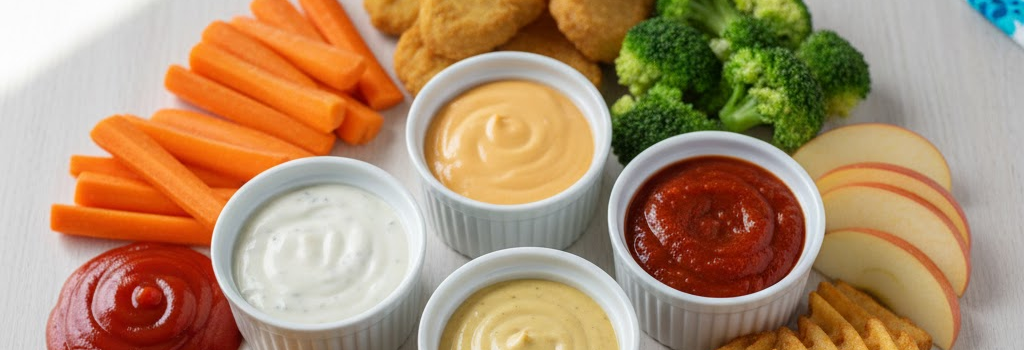
If you've ever watched your kid refuse a chicken nugget and then devour the same chicken nugget after dunking it in ketchup, you already understand the power of dipping sauces. You just might not realize how far that power extends.
Dipping isn't a phase or a quirk. For picky eaters, it's one of the most effective tools you have. And once you understand why it works, you can use it strategically to introduce foods your kid currently won't touch.
Why Dipping Works for Picky Eaters
There are three reasons dipping is so effective, and none of them have to do with the sauce tasting good (though that helps).
It gives them control
The number one thing picky eaters crave isn't a specific food—it's control over what goes in their mouth. Dipping hands that control directly to the child. They decide how much sauce. They decide which piece gets dipped. They decide whether to dip at all. That autonomy reduces the anxiety that drives most food refusal.
It makes texture predictable
Many picky eaters are texture-sensitive. A dry piece of chicken feels one way. That same chicken coated in a thin layer of smooth sauce feels completely different—more uniform, easier to process, less surprising. The sauce acts as a texture buffer between the food and their mouth.
It turns eating into an activity
Eating can feel like a chore for kids who don't enjoy food. Dipping turns it into something to do. There's a physical action involved—pick up food, dip, eat. That engagement changes the entire mealtime dynamic from "sit here and eat this" to "here's something interactive."
10 Sauces That Actually Work
Not all sauces are created equal when it comes to picky eaters. These ten are the ones parents report the most success with, ranked roughly by how widely accepted they tend to be.
1. Ketchup
Let's start with the obvious. Ketchup is the gateway dipping sauce for a reason—it's sweet, it's smooth, it's consistent, and virtually every kid in America has tasted it. If your kid doesn't dip yet, ketchup is where you start.
Best paired with: Chicken nuggets, fries, meatloaf, hamburgers, scrambled eggs (yes, really—lots of kids do this)
Level it up: Mix ketchup with a tiny bit of BBQ sauce to create a slightly more complex flavor. If they accept that, you've just expanded their sauce repertoire without introducing anything unfamiliar.
2. Ranch Dressing
Ranch is the second most universal kid sauce. It's creamy, it's mild, and it pairs with almost everything. A lot of kids who won't eat a raw vegetable will eat a raw vegetable dipped in ranch. That alone makes it worth keeping in the fridge at all times.
Best paired with: Carrot sticks, cucumber slices, chicken tenders, pizza (yes, pizza dipped in ranch—embrace it), fries
Level it up: Make a simple homemade version with Greek yogurt, a squeeze of lemon, garlic powder, and dried dill. Same flavor profile, more protein, and you can adjust thickness to your kid's preference.
3. Honey Mustard
Honey mustard hits a sweet spot (literally) between ketchup and ranch. It's sweet enough to feel safe but has just enough tang to introduce a new flavor dimension. Kids who are ready to move beyond ketchup often land here.
Best paired with: Chicken tenders, pretzel bites, ham, turkey slices, roasted sweet potato
Make it at home: Equal parts honey and yellow mustard—that's it. Adjust the ratio to your kid's preference. More honey for sweeter, more mustard for tangier. Let them help mix it so they feel ownership over the flavor.
4. Cheese Sauce
Melted cheese in dippable form. This is the sauce for kids who live on cheese and dairy. You can make it from scratch or use jarred queso—no judgment here, because the goal is getting your kid to eat the thing they're dipping into it.
Best paired with: Pretzel bites, broccoli, tortilla chips, plain pasta, bread sticks, cauliflower tots
Level it up: Stir in a spoonful of pureed butternut squash or sweet potato. The orange color is already there from the cheese so it blends right in, and you've just added a vegetable to their cheese sauce without them knowing.
5. Marinara Sauce
Some kids won't eat pasta with red sauce but will happily dip breadsticks or mozzarella sticks into the same exact sauce. The difference is control. When sauce is already on the food, it's unpredictable—too much in one spot, not enough in another. When they dip, they control the amount perfectly.
Best paired with: Mozzarella sticks, bread sticks, pizza rolls, chicken parmesan strips, grilled cheese strips
Picky eater note: Serve it slightly warm, not hot. Temperature sensitivity is real for a lot of picky eaters, and a sauce that's too hot can shut down the whole meal.
6. BBQ Sauce
BBQ sauce is sweet, tangy, and smoky—a more complex flavor than ketchup, but in the same family. Kids who already like ketchup often accept BBQ sauce without much resistance.
Best paired with: Chicken nuggets, pulled pork, meatballs, corn on the cob (brushed on), fries
Strategy: If your kid only eats ketchup, try mixing a tiny amount of BBQ sauce into their ketchup. Gradually increase the ratio over a few weeks. By the time it's mostly BBQ sauce, they've already been eating it for days.
7. Peanut Butter Dip
Not technically a sauce, but peanut butter (thinned with a little honey or maple syrup) is an incredible dipping option for picky eaters, especially for fruit and breakfast foods. It adds protein and healthy fats to whatever they're eating.
Best paired with: Apple slices, banana, celery (the classic), pretzels, toast strips, pancake strips
Allergy note: Obviously skip this one if nut allergies are a concern. Sunflower seed butter is a solid substitute with a similar texture and sweetness.
8. Yogurt Dip
Plain Greek yogurt mixed with a little honey makes a protein-packed dip that works for both sweet and savory foods. It's tangy enough to be interesting but mild enough not to scare anyone off.
Best paired with: Fruit (strawberries, blueberries, melon), granola, crackers, sweet potato fries
Variations: Add a pinch of cinnamon for fruit dipping. Add a tiny bit of ranch seasoning for a savory version that works with vegetables. Same base, completely different applications.
9. Hummus
Hummus is a tougher sell for some picky eaters because the texture is thicker and the flavor is more complex. But for kids who accept it, it's a nutritional powerhouse—protein, fiber, and healthy fats all in one dip.
Best paired with: Pita chips, cucumber rounds, carrot sticks, bell pepper strips, crackers, pretzel crisps
Start here: Try a smooth, store-bought variety before attempting homemade. Sabra classic is a reliable starting point. Avoid chunky or heavily seasoned varieties for first-timers.
10. Sour Cream
Mild, cool, creamy. Sour cream works for kids who like dairy but find ranch too flavorful. It's also a natural pairing for Mexican-style foods, which tend to be well-accepted by picky eaters because of the cheese and carb components.
Best paired with: Quesadillas, tacos, burritos, baked potatoes, taco meat, tortilla chips
Level it up: Mix in a small amount of mild salsa for a creamy dip that introduces tomato flavor without the texture of actual tomatoes.
What to Dip: The Best Foods for Sauce
If you're going to lean into the dipping strategy, pair these sauces with foods that are already easy to eat with hands:
Proteins: Chicken nuggets, chicken tenders, meatballs (on toothpicks), deli meat rollups, mini corn dogs
Carbs: Pretzel bites, bread sticks, tortilla chips, pita triangles, bagel chips, toast strips, fries
Vegetables (the real goal): Carrot sticks, cucumber rounds, bell pepper strips, celery, steamed broccoli florets, sweet potato fries, cauliflower tots
Fruit: Apple slices, strawberries, banana chunks, melon cubes, grapes (halved for little ones)
The key is offering a mix. Put out a dipping sauce with three or four things to dip, and let your kid choose. If they only dip the pretzels, that's fine. The carrot sticks were on the plate. They saw them. That exposure counts.
The Gateway Strategy
Here's where dipping becomes a real feeding tool, not just a mealtime hack.
Phase 1: Start with what they already eat
Pick your kid's most accepted food and add a dipping sauce to it. Chicken nuggets with ketchup, fries with ranch, whatever. The goal is just to get them comfortable with the act of dipping. No new foods yet.
Phase 2: New sauce, same food
Once they're happily dipping, introduce a new sauce alongside the familiar one. "Here's your ketchup, and here's honey mustard if you want to try it." No pressure. Just availability. It might take a few meals before they try it, and that's normal.
Phase 3: Same sauce, new food
This is the real move. Take a sauce they already love and pair it with a food they haven't accepted yet. If they love ranch, put ranch next to raw carrots. If they love cheese sauce, put cheese sauce next to broccoli. The familiar sauce lowers the barrier to trying the unfamiliar food.
Phase 4: Gradually reduce
Over time—and this is a slow process, think weeks or months—you can start putting less sauce on the plate. Not to take it away, but because your kid will naturally start needing less of it as they become more comfortable with the foods themselves.
Don't rush this phase. If your kid dips every single bite in ranch for a year, they're still eating vegetables. That's the win.
Common Mistakes
Offering too many choices at once. Two sauces max. More than that overwhelms most picky eaters and leads to decision paralysis—which looks a lot like food refusal.
Taking the sauce away too soon. If your kid is eating broccoli because of cheese sauce, the cheese sauce is working. Don't remove the thing that's working because you want them to eat broccoli "the right way." There is no right way. There's eating it and not eating it.
Making it a reward. "Eat three bites and then you can have the dipping sauce" turns the sauce into a reward and the food into a punishment. Just put both on the plate from the start.
Forcing the dip. If your kid wants to eat chicken nuggets plain, let them. The sauce should be an option, not a requirement. Some days they'll dip, some days they won't. Both are fine.
The Bottom Line
Dipping sauces are one of the simplest, most effective tools in the picky eater toolkit. They give kids control. They smooth out textures. They make eating more interactive. And when used strategically, they can be the bridge between "I won't eat that" and "actually, that's not bad."
Keep a few options in your fridge. Put them on the table without commentary. Let your kid do their thing. You might be surprised what they're willing to try when they can dip it first.